MULTIPLATES Journal
How to assess a UAE number plate listing: warning signs and questions
A risky listing is not automatically fraud. It is a post where an important fact cannot be checked or the wording is stronger than the evidence. Before enquiring, separate visible signals from source claims, save the date and ask neutral questions without accusing a seller or platform.

Signals that need checking
Take care when there is no date, source, code or clear vehicle type; one photograph is paired with “ready to transfer”; price has no composition; “rare” is unexplained; or different objects use identical-looking cards. No single signal proves wrongdoing. It means the claim needs checking.
A mobile number adds a privacy risk because it may be an active contact channel. Do not call an owner or send an SMS just to test it without a proper basis. Do not expose a seller’s contact from a listing.
Checklist before contact
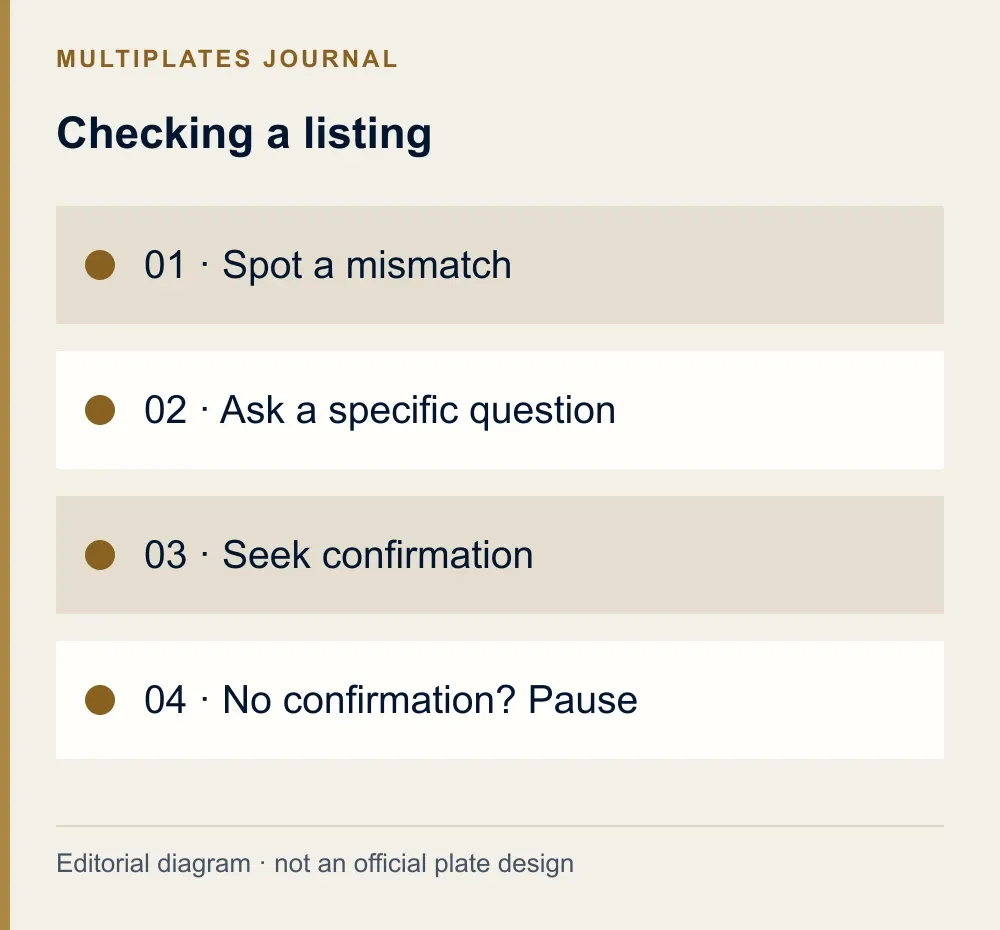
Save URL, ID and date. Record only what is visible: emirate, vehicle type, code, digits, border and image quality. Copy source claims — category, availability and price — into a separate field and mark them unconfirmed. Compare with the relevant emirate’s official service.
Ask neutrally: “What source and check date support this? What is actually current? What does the amount include? What official next step applies?” If there is no answer, pause the enquiry rather than calling the post fraudulent.
How to compare sources
An official page can support a procedure but not a particular private sample. A third-party catalogue may show a public photograph but not publication rights or ownership. An original diagram can explain a pattern but is not a certificate. Record the result as sample found, characteristic confirmed, availability or unknown.
Price is not proof
A high or low price alone does not prove fraud or rarity. Compare the same object by emirate, vehicle, category, code, digits, date and conditions. Ask for price composition and do not present a final amount before checking.
A safe next step
When a source answers partially, retain the unknown and ask one focused question. Never send OTPs, passwords, banking data or documents through an open message. For a mobile number, check operator and portability separately; for a vehicle plate, use the emirate’s official context. [TDRA — Porting Numbers] [Dubai RTA — Driver and Car Owner]
Two hypothetical listings
In the first listing, the photograph is angled and the caption contains one extra character. This may be a framing error, an old template or an inaccurate description; by itself it is not a crime or proof of deception. Save the link, date and public fields, then ask politely: “The code looks like A in the image, while the text says B. Which is correct, and what source supports it?” An answer that acknowledges an error and provides a check date is more useful than an accusation. Until explained, mark the mismatch unknown and do not repeat the stronger claim.
In the second listing, a price is paired with a request to send an OTP, document copy or card data in chat. This is a security risk, separate from whether the photograph is accurate. Do not send the data, follow an unknown payment link or continue payment. Save the public URL without private correspondence, stop contact and use the intended official channel. If reporting the card, provide its public ID and risk description without copying personal data.
Signal, question and inference limit
Signal “no date” → ask “When and where was it checked?” → the reply does not prove current status. Signal “code and image conflict” → ask “Which code is correct and is there a primary source?” → the reply does not prove seller authority. Signal “price without composition” → ask “What does it include and what may change?” → the amount is not a final total. Signal “urgent OTP or document request” → stop data sharing instead of continuing in that channel → the card does not prove transaction safety.
| Signal | Action | Still unconfirmed |
|---|---|---|
| No date | Ask when it was checked | Current availability |
| Code differs from image | Ask for the full designation | Seller authority |
| Unitemised price | Ask what is included | Total cost |
| One-time code requested | Stop sharing data | Transaction safety |
How to preserve checking details without unnecessary data
For a vehicle plate, keep the listing link, public ID and viewing date; the full combination is relevant only to that vehicle sample. If it is a mobile number or contact phone, do not copy it in full: use a mask or the last digits. Record the stated category, price and questions about the description separately. If you share a screenshot, conceal other people’s documents and contact details.
Information checking is not a deal guarantee
A careful comparison confirms only what was actually checked. A readable code in a photograph does not establish seller authority, and an official service description does not guarantee that a particular number can be processed. Before a financial decision, clarify rights, availability, the total amount, payment arrangements and the applicable procedure separately. A general assurance that everything is safe does not replace an answer on each important term.
FAQ
Can a high price make a listing fraudulent? No. Does a photograph prove ownership? No. What if code and description conflict? Record the conflict and request the source. When should an option be paused? When a key fact cannot be confirmed or the request requires unsafe data.
Sources and fact checking
- TDRA — Porting NumbersChecked:
- Dubai RTA — Driver and Car OwnerChecked: